Space concept film
Edit together, save space: a 38-second film drawn in code, where every pencil line moves the camera and every sound follows the motion.
- Context
- Independent concept
- Contribution
- Direction, motion, and sound
- Period
- November 2026
- Explore
- Visit spacefs.com ↗
The project
Space (spacefs.com) is a filesystem that keeps files in the cloud while they look and open like local ones. I made an unofficial concept film for it about one specific use: a team editing a 412 GB 8K project together without anyone downloading or copying it. The film is a single HTML file with one clock, rendered frame by frame to 1080p at 60 fps. I directed AI coding agents through the motion, the generated imagery, and a sound design built from the film’s own animation data. It is a personal concept, not made for or endorsed by Space.
Pencil on paper, picture and sound.
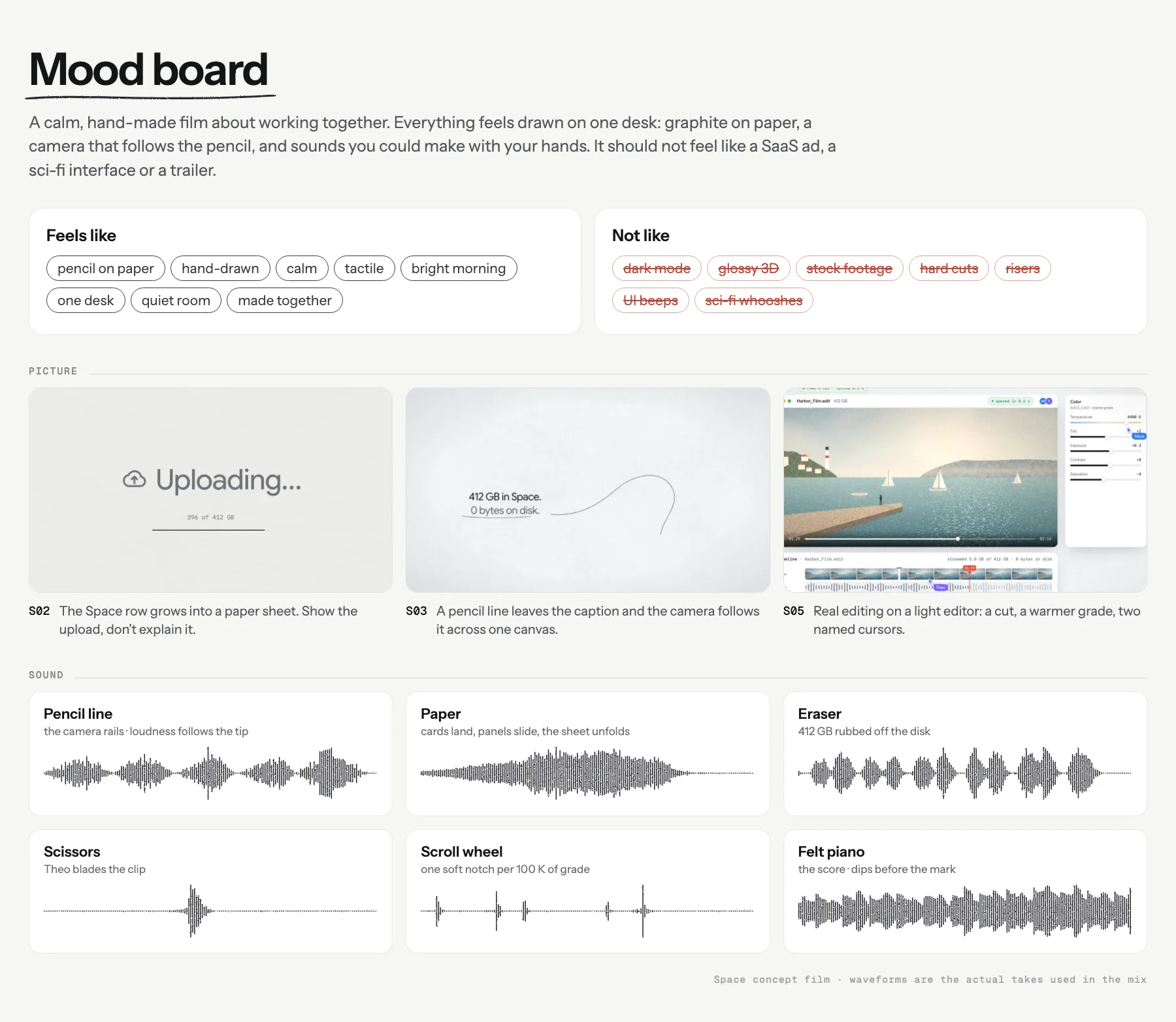
The film’s direction fits on one mood board with two halves, picture and sound: pencil on paper, a bright morning, one desk, sounds you could make with your hands. It also names what to avoid: dark mode, glossy 3D, stock footage, risers, and UI beeps. Every screen is rebuilt from spacefs.com’s own interface: Finder windows, the Space drive in the sidebar, Google Sans, and two-tone headlines. The editor view follows the layout of modern video editors without borrowing any branding.
One canvas instead of seven scenes.
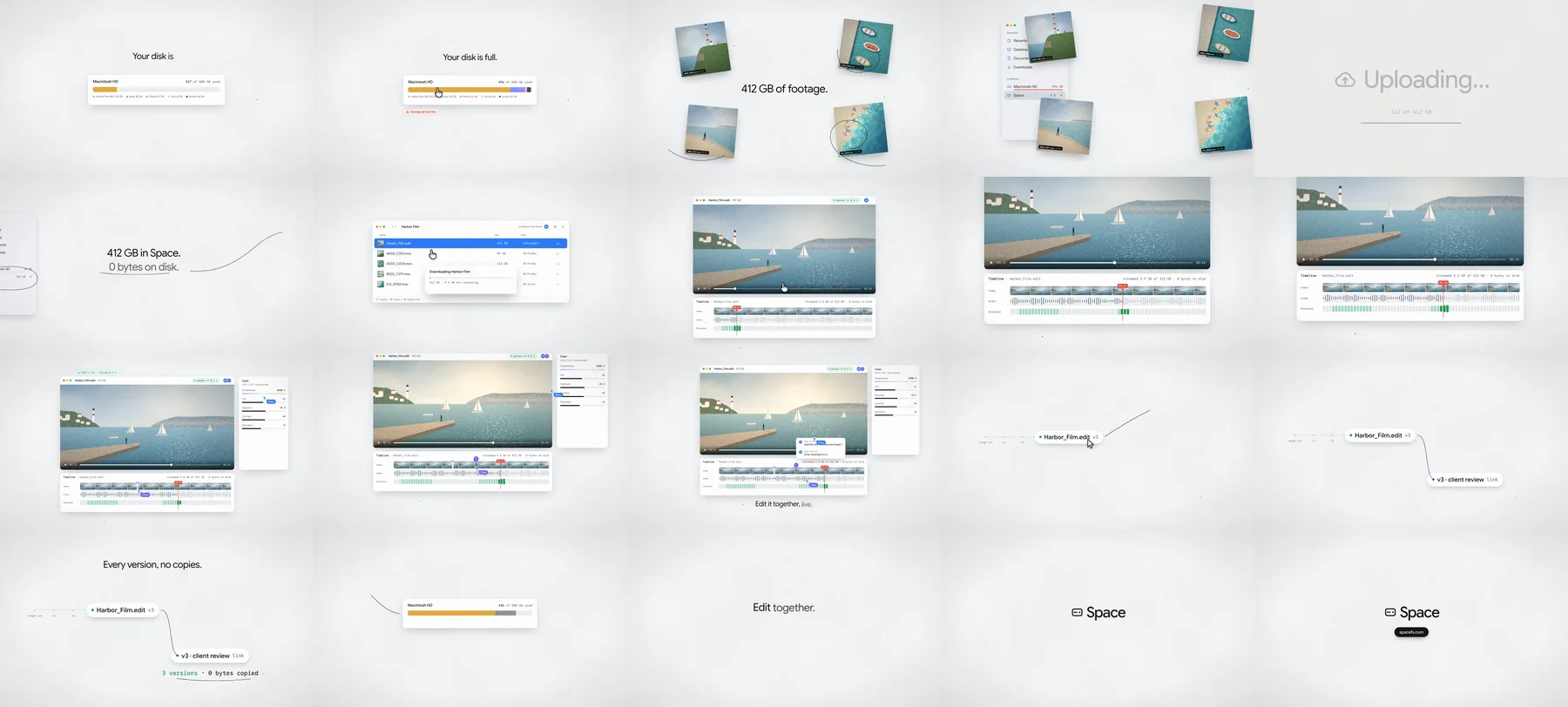
The first cut dipped to black between scenes, and the motion felt stitched together. In the final cut every scene sits at its own place on one large dot-grid canvas. At each change a pencil line draws out of the last caption, the camera rides that curve to the next scene and zooms out slightly mid-pan, and the line retracts into the panel it reaches. Motion blur appears only at the fastest point of each pan. An abstract “thinking” beat became something you can see: the Space row grows into a sheet that counts the upload from 0 to 412 GB, folds back into the row, and the disk drains.
Footage made in code.
The project in the film needed footage that looked like a real shoot without stock photos or anyone else’s work. A Python script paints a bright harbor morning: a lighthouse, moored boats seen from above, a beach walker, a drone shot of the bay, and the wide shot in the editor’s player. The four clips keep camera-style names and sizes (A003_C001.mov, 96 GB) so the 412 GB adds up.
Sound driven by the animation.
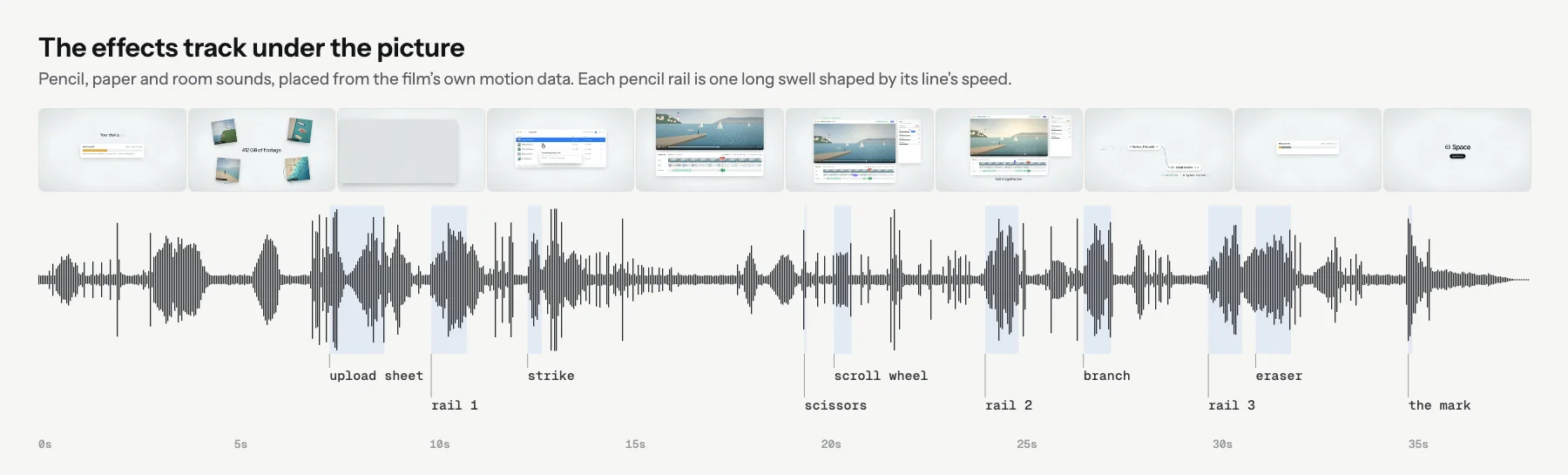
Every sound is pencil, paper, or a quiet room, generated with ElevenLabs. The film exports its own motion every 10 ms: where each pencil tip is and how fast the camera moves. A pencil line’s loudness follows its tip’s speed and its stereo position follows the tip across the screen. The camera gets a soft air whoosh only when it moves fast. Freeing disk space is an eraser, Theo’s cut is a scissors snip, and the logo gets the film’s only low note after half a second of near silence. Clicks and impacts land within 35 ms of their frame, most within 10, and the master sits at −16 LUFS, quieter than usual for social on purpose.
Notes fixed at the source.
Review notes were fixed in the film file, not patched in the edit. The version timeline’s last node sat 12 pixels off the green dot in the v3 pill, so the history now steps back from that dot. The colour slider sounded like writing, which made no sense for a hand on a control, so it became a soft scroll-wheel detent for every 100 K the readout passes, quieter where the drag is fastest and firmest where it settles. Because picture and sound share one timeline, each note took one change and one re-render.
Pencil sketch and sound.
What the film should and should not feel like, the frames that set the look, and the sound palette, each family drawn from the take it uses.
Moments from the final cut.
The upload, a pan along a pencil line, live editing, sharing a version, freeing the disk, and the mark.
Picture and sound on one timeline.
The final cut at a glance, and the sound laid against it: pencil strokes swell and fade with the lines they follow.