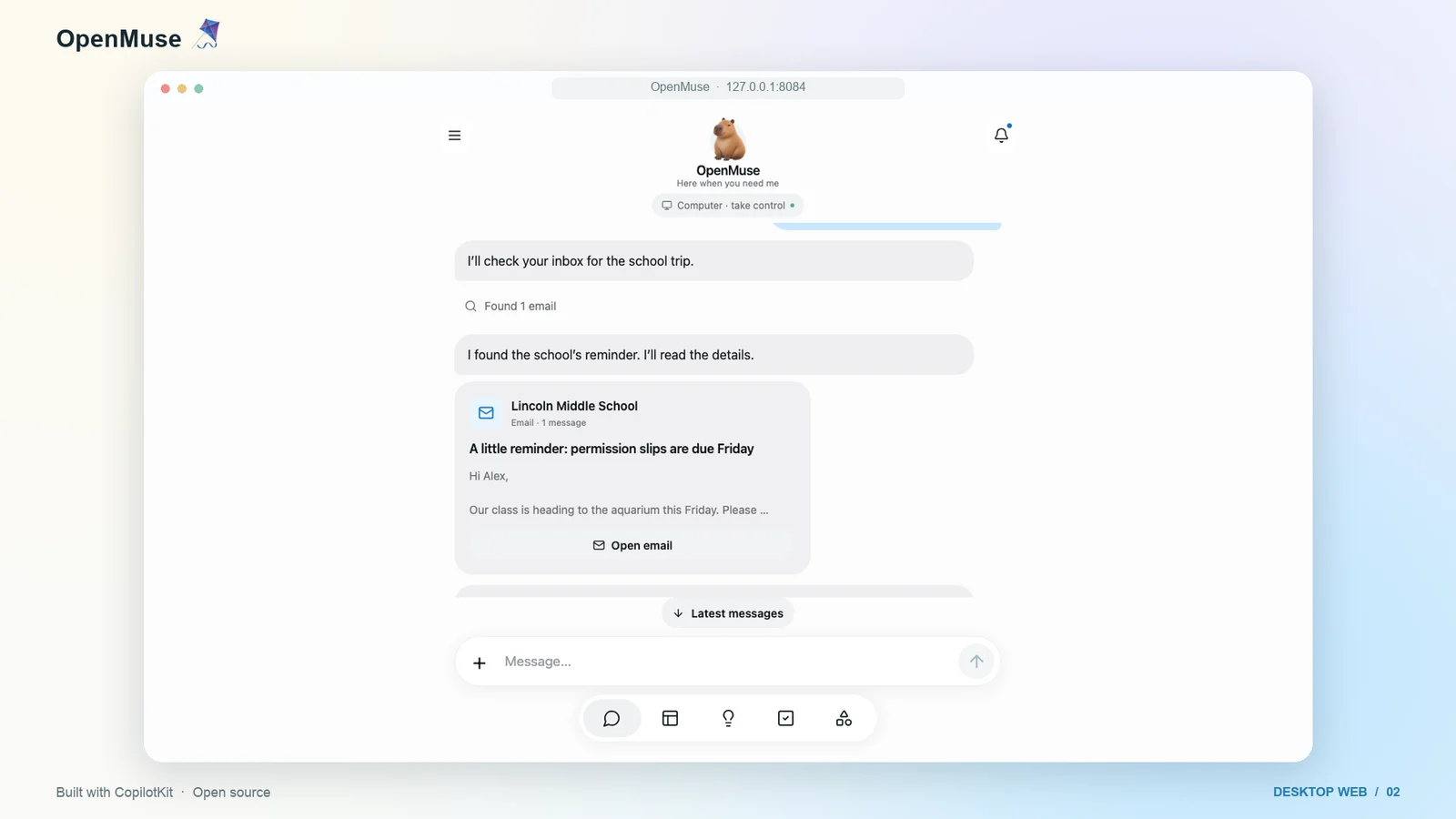
OpenBot
Autonomous coworkers you can direct and recover.
- Context
- CopilotKit
- Contribution
- Agent controls, reliability, conversational authoring & internal deployment
- Period
- August–October 2026
- Explore
- View on GitHub ↗
- authored PRs merged upstream
- 10
- repository forks
- 1,219
Authored PRs counted October 5, 2026; forks observed November 2, 2026.
The project
I extended OpenBot’s existing agent platform with human approvals, queued corrections, repetition detection, and stalled-stream recovery. I then made skills and coworkers configurable through conversation and maintained a separate internal deployment.
The challenge: make autonomy manageable.
A coworker with a browser, files, and tools needs controls people can use while it works. Users need to authorize a specific action, correct a running task, recognize repetition, and recover when an agent stops responding.
Approve one action, once.
I added an ask outcome to the existing action policy while preserving hard denials. Approval is bound to the action and its arguments, single-use, and time-limited. The same mechanism covers computer actions and external tool calls. Pending approvals are held in memory, so they do not survive a restart.
Correct the task without racing the tools.
Messages entered while a Bot was busy had remained unsent. I added visible queued corrections and an ordered follow-up turn. Tracking the whole logical turn keeps the queue from draining between a model response and its tool continuation. This queue serves the active session and does not survive a page reload.
Make loops and stalls observable.
I added action fingerprints and a repetition count to the existing policy gateway, letting operators decide how to handle repeated behavior. A separate watchdog monitors silence in the upstream event stream, cancels a stalled run, and surfaces an error instead of leaving the interface indefinitely busy.
Create coworkers through conversation.
A Bot can help draft a skill or coworker and show the full proposal for review. Saving uses the signed-in person’s existing ownership rules; creating a coworker does not automatically grant connector access. I also fixed role edits so the model’s effective instructions follow the updated role shown in the UI.
The result.
Ten authored PRs merged upstream by October 5, delivering practical controls for supervising agents and configuring their work. Separately, I maintained an internal fork with Slack transcript persistence and deployment fixes. The broader project reached 6,074 stars and 812 forks by October 5. In late October, during the launch week of OpenDuet, which I built on OpenBot, OpenBot made GitHub Trending for the first time and passed 9,900 stars.
Launch & reach
Built to be used.
Shared with the world.
The launch introduced OpenBot’s AI coworkers, generative interfaces, and computer use to the developer community. I built the controls that make those agents safe to supervise: approvals, corrections, and recovery.
The embedded announcement shows the public launch and its engagement.
View the launch announcement on X ↗